
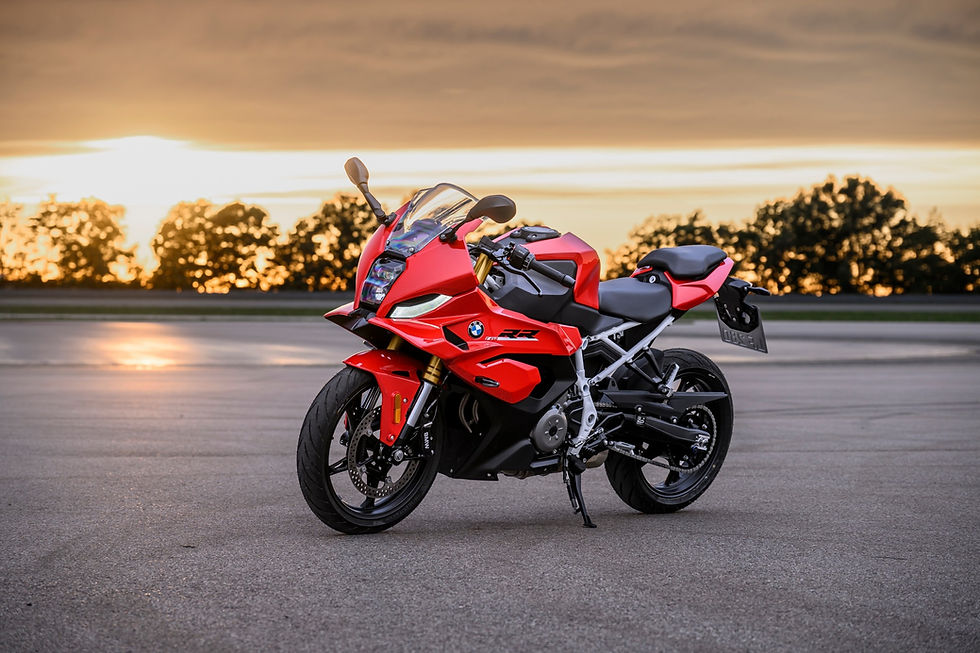
1.3 kg lighter, more feel: The new M Motorsport frame of the BMW M 1000 RR.

When people talk superbikes, they talk horsepower, winglets and electronics. Yet one part you barely see decides whether you trust a bike at full lean: the frame. That is exactly where BMW Motorrad is stepping things up on the M 1000 RR. From model year 2027, the third generation of the M Motorsport frame comes as standard – and it is not just lighter, it is deliberately "softer" in the right places.
Stiff doesn't automatically mean fast
For a long time, frame design followed a simple rule: the stiffer, the better. Today we know better – and racing showed the way.
The problem is pure physics. With the bike upright, the fork and shock absorb bumps without issue. But at deep lean in a corner, road impacts increasingly act across the direction of the suspension travel, so the suspension can only deal with part of them. If the frame is rock-solid at that moment, every imperfection goes straight to the tyre – the wheel skips, grip fluctuates and the rider loses confidence.
The answer: the new frame is allowed to deform elastically sideways within a precisely defined range. At lean, it effectively becomes an additional suspension element. Longitudinally, however, the chassis stays uncompromisingly stiff – because under hard braking and on the exit, forces need to arrive without detours.
The numbers behind the concept
Around 1.3 kg weight saving over the previous version – at a central point of the bike, which you notice in quick changes of direction.
Wall thicknesses reduced by up to 30 percent – the real lever the engineers use to balance stiffness and flex.
Four aluminium castings make up the frame: steering head, left and right side sections and the rear section.
For riders, this should mean more precision on turn-in, clearer feedback from the front wheel and more consistent tyre contact. A nice bonus for trackday regulars: the tyre should also wear more evenly.
Three plants, one frame
How the part is made is just as interesting. BMW splits the work across three sites, each bringing its own speciality:
Munich – the brain. In development, geometry, wall thicknesses and stiffness distribution are defined digitally. Then comes the hard part: simulation, test rigs and finally riding tests.
Landshut – the casting. BMW Group Plant Landshut is the group's go-to address for light alloy. The four thin-walled parts are made by low-pressure die casting: the molten aluminium is pushed into the mould calmly and in a controlled way rather than shot in, which reduces air pockets. The internal cavities are formed by sand cores produced using the cold-box process. Even before the first tool is built, BMW simulates how the sand mixture behaves during core shooting. Finally, every part goes through X-ray inspection and the measuring machine.
Berlin – the finish. At the Spandau motorcycle plant, the lead plant of BMW Motorrad, the four castings are TIG-welded together. The frame then receives a cathodic dip coating for corrosion protection that also reaches the cavities. Finally, mounting points and functional surfaces are milled to final dimensions and the complete frame is measured once more – only then does it go to assembly.
From the factory team to your garage
This frame is not just a production part with a racing sticker. It is the common foundation for the BMW factory teams, customer racing worldwide and the road bike. What is learned in competition feeds directly into the design – and in return, privateer teams get a chassis designed to work on circuits of very different character straight out of the box.
For BMW Motorrad Motorsport boss Sven Blusch, it is precisely this interplay of lightweight design, tuned elasticity and the expertise of all three sites that unlocks more grip and more precise chassis performance.
1.3 kilograms sounds unspectacular on paper. But the real story is a different one: BMW no longer treats the frame as a rigid skeleton, but as a finely tuned chassis component. It's the kind of detail work you barely notice in a brochure – but feel very clearly on your third lap of the Ring.
Whether the promise of more confidence at lean holds up will only be shown by a riding impression.
Meine Blog Artikel erstelle ich aus folgenden Quellen und Hilfsmittel:
Quellen: BMW Press Group, Google, Instagram, Erfahrungen aus dem Auto Gewerbe
Hilfsmittel: Für die Grammatik der Texte nutze ich Google Gemini und Claude

Comments