
BMW Electric Vehicle Maintenance: What Owners Really Need to Know.
Anyone switching from a combustion engine to an electric BMW eventually asks the same question: how much maintenance does a car like this actually still need once oil changes, timing belts and exhaust systems are gone? The short answer: less, but not zero. Here's what matters when it comes to servicing BMW iX, i and Neue Klasse models.
Fewer wear parts, but not maintenance-free
An electric motor has significantly fewer moving parts than a combustion engine — no oil circuit, no timing belt, no exhaust system. That noticeably reduces the classic maintenance workload. For its BEV models, BMW uses a Condition Based Service system: sensors in the vehicle continuously monitor wear and fluid levels and automatically flag when a service is due, rather than relying on rigid mileage intervals like in the past.
Still, regular checks remain essential — not least for warranty and safety reasons.
Service intervals at a glance
Even though BMW BEV models follow a needs-based servicing approach, there are fixed points that apply regardless of driving behavior:
Safety check: typically every 2 years, regardless of mileage
Brake fluid: replaced every 2 years, since it absorbs moisture over time regardless of use
Air conditioning: cabin filter and refrigerant circuit are checked as part of the inspection
High-voltage system: the electric motor and high-voltage battery are read out using special BMW diagnostic software
12V battery: even a BEV needs a conventional 12V battery for onboard electronics — its condition is checked at every service
Cooling circuits: coolant for the high-voltage battery and cabin heating is checked and topped up if needed
At higher mileages (from around 120,000 km), additional checks on the suspension, steering and shock absorbers are added — here a BEV barely differs from a combustion-engine car.
The high-voltage battery: centerpiece and warranty case
The biggest concern for many buyers is battery degradation. BMW has addressed this since April 1, 2025 with the BMW Battery Certificate: it guarantees a minimum capacity of 70% for 8 years or 160,000 km — whichever comes first — for all fully electric new BMW vehicles. If the measured capacity falls below this threshold during that period, the capacity loss is remedied free of charge, either through repair or replacement with new, remanufactured or reconditioned parts. This explicitly also applies to vehicles bought used.
In practice, this means that anyone who brings their BMW BEV in for regular inspections gets the battery capacity checked at the same time — a simple way to catch potential issues early.
Brakes: regeneration extends their life
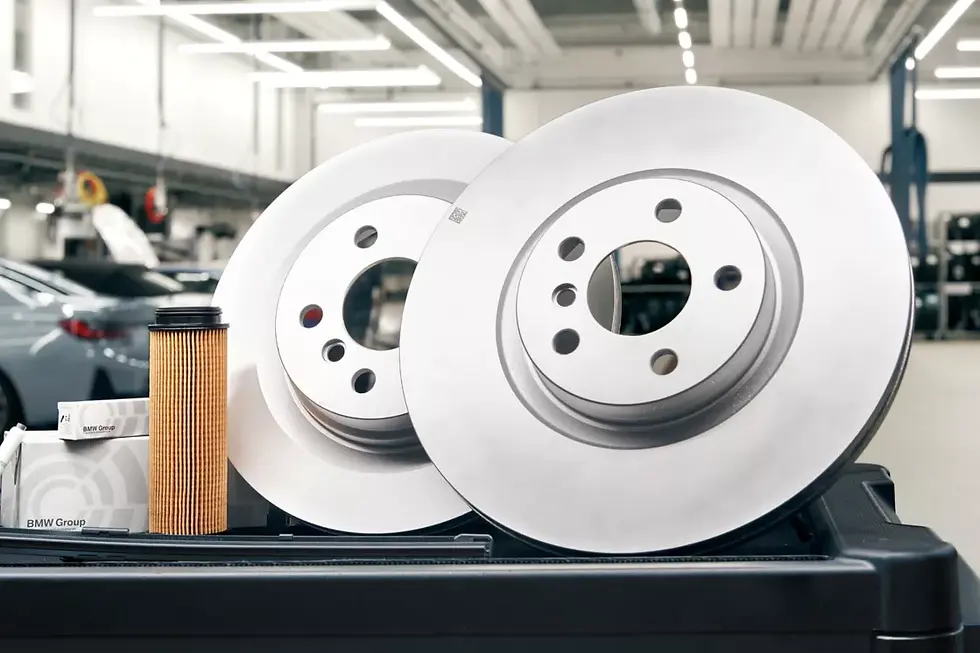
An often underestimated advantage: regenerative braking, which feeds kinetic energy back into the battery when decelerating, puts significantly less strain on the mechanical brakes. Brake pads and discs tend to last noticeably longer for many BEV drivers than on comparable combustion-engine cars. Regular visual inspection remains important nonetheless, since brakes that are rarely used mechanically can occasionally develop surface rust.
Tires: more weight, more torque
What BEV owners do tend to replace more often are tires. The higher vehicle weight from the battery and the instant torque of the electric motor lead to somewhat faster tire wear. BMW recommends tires specifically approved for its electric models, optimized for rolling resistance and load capacity — a point not to overlook when replacing tires, as standard tires can noticeably reduce range.
Software: maintenance you barely notice
A growing share of "maintenance" today happens over the air: Remote Software Upgrades deliver new features, efficiency improvements and bug fixes directly to the vehicle without a workshop visit. With Neue Klasse models running the new BMW Operating System X, this channel is becoming increasingly important.
What does this mean for maintenance costs?
Overall, independent studies and service schedules show that maintenance costs for BMW BEV models are lower over the vehicle's lifetime than for comparable combustion-engine cars — mainly because larger, expensive wear parts like the clutch, turbocharger or exhaust system are eliminated entirely. The savings partly shift toward the more complex diagnostics of the high-voltage battery and electric motor, which require specialized equipment and trained staff — one reason independent garages are often still cautious with BEV work, and a visit to an authorized BMW dealer remains advisable
BMW electric vehicles aren't maintenance-free, but the type of upkeep shifts: away from mechanical wear parts, toward battery and software diagnostics. Regular inspections let owners benefit from the Battery Certificate, regenerative braking eases wear on the brakes, and tire wear is the main thing to keep an eye on.
Meine Blog Artikel erstelle ich aus folgenden Quellen und Hilfsmittel:
Quellen: BMW Press Group, Google, Instagram, Erfahrungen aus dem Auto Gewerbe
Hilfsmittel: Für die Grammatik der Texte nutze ich Google Gemini und Claude


Comments