
BMW Round Cells: The Neue Klasse's Sixth-Generation High-Voltage Battery, Explained.

With the Neue Klasse, BMW isn't just ushering in a new era visually and digitally – plenty is happening under the sheet metal too. At the heart of it is the sixth generation of BMW eDrive technology (Gen6), and its most important innovation is arguably the switch from prismatic cells to round cells. We explain what's behind it, which sizes exist, which models already use the new battery technology – and whether MINI benefits from it too.
What makes the round cell so special?
Until now, BMW relied on prismatic cells in its electric vehicles. With the Neue Klasse, the manufacturer is making the switch to a cylindrical format. According to BMW battery expert Peter Lamp, the main reason is safety: the round shape can be integrated into the vehicle more mechanically stable and reduces the risk of thermal runaway, which increases with rising energy density.
Technically, the round cell brings several advantages at once:
Around 20 percent higher energy density compared to the previous prismatic Gen5 cells
Up to 30 percent more range and up to 30 percent faster charging at the vehicle level
800-volt system voltage for the first time, up from 400 volts previously
Cell-to-pack principle: the round cells are integrated directly into the battery housing without an intermediate module step
Pack-to-open-body: the high-voltage battery itself takes on the role of a structural component within the body
What sizes are available?
The new BMW round cells have a uniform diameter of 46 millimeters. Differences exist in height: depending on the packaging in the vehicle floor, the cells come in two height variants – 95 mm and 120 mm. This allows the high-voltage battery to be flexibly integrated into different models and segments independent of vehicle height, from compact SUVs to BMW M's high-performance models.
The cells are manufactured at six locations worldwide, including through partners CATL and EVE Energy. Pilot production has already started at the Battery Cell Competence Center (CMCC) in Parsdorf near Munich.
Which models currently use the round cell?
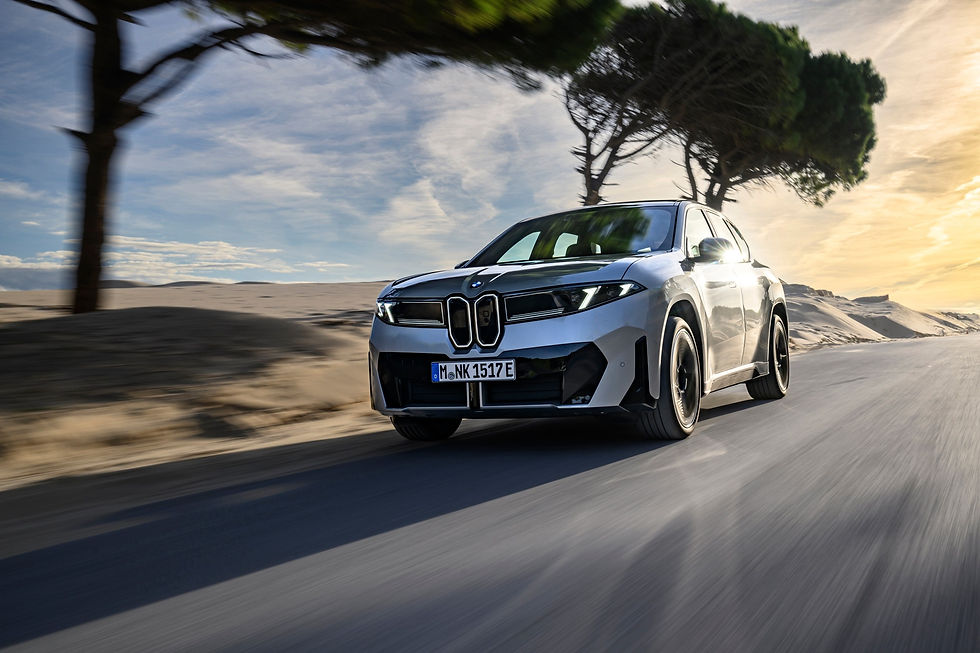
The BMW iX3 (NA5) leads the way as the first Neue Klasse production model, which has been delivered since spring 2026. As a taller SUV, the iX3 uses the 46120 cell format (46 mm diameter, 120 mm height) – the greater height allows for more active material and thus more usable capacity:
iX3 50 xDrive: 108 kWh battery capacity, 46120 cell format, up to 805 km range (WLTP), up to 400 kW charging power
iX3 40 (entry-level rear-wheel-drive variant since summer 2026): 82.6 kWh, also 46120 cell format, up to 635 km WLTP, up to 300 kW charging power
The BMW i3 sedan (NA0) follows as the second model, with series production starting in August 2026. Because the flat sedan body requires a lower center of gravity, the i3 uses the shorter 4695 cell format (46 mm diameter, 95 mm height). Despite the smaller cell height, the battery reaches the same 108.7 kWh capacity (NMC cells from CATL and EVE Energy) as the iX3 – made possible by the sedan's larger floor area. Thanks to better aerodynamics, this is enough for up to 900 km of range according to WLTP.
A clear logic is emerging here: 4695 for flat vehicles like sedans, 46120 for taller SUVs.
For the coming years, BMW has announced a veritable model boom: by the end of 2027, around 40 new or updated models in total are set to be equipped with Neue Klasse technology. Next up are, among others, the iX4, the new X5/iX5, and further down the line i1, i2, and iX2. According to insider reports, the upcoming iX1 (NB5), whose production start is expected in November 2027 in Regensburg, is also set to use the more compact 4695 cell format – the battery is likely to be smaller than the iX3's due to the shorter wheelbase, but should clearly exceed the current model's range. Even BMW M's high-performance models are set to run on Gen6 round cells in the future.
And at MINI – are round cells coming there too?
Not yet, currently. Today's electric MINIs – Cooper E/SE and Aceman E/SE – are based on a platform co-developed with Chinese partner Great Wall and continue to rely on fifth-generation prismatic cells. Battery sizes here range from around 40.7 to 54.2 kWh depending on the model.
That's likely to change in the medium term, though: according to insider reports, the next MINI Countryman (internal codename NE5) is set to switch to the Neue Klasse platform. This would make it technically closely related to the upcoming BMW X1 (NB5), whose production start is expected by the end of 2027 – the Countryman successor is likely to launch around the same time, presumably from 2028. Only then would a MINI run on the new 46mm round cells for the first time.
With the switch to the round cell, BMW is making one of the biggest technical leaps in its e-mobility history: more energy density, more range, faster charging, and a battery concept that simultaneously serves as a structural component of the body. Currently, the iX3 and i3 benefit from it, and in the coming years practically the entire BMW model range will follow. MINI fans, on the other hand, will have to be a bit more patient – but the next Countryman looks set to become the first MINI with round-cell technology.
All figures are based on the current state of knowledge (August 2026) and official BMW communications as well as industry reports. Changes are possible for future models not yet officially confirmed.
Meine Blog Artikel erstelle ich aus folgenden Quellen und Hilfsmittel:
Quellen: BMW Press Group, Google, Instagram, Erfahrungen aus dem Auto Gewerbe
Hilfsmittel: Für die Grammatik der Texte nutze ich Google Gemini und Claude


Comments