
From Bar Handle to Sensor Surface: The Quiet Evolution of BMW Door Handles.
You usually only notice them when they stop working. The door handle is one of the least conspicuous parts of a car – and at the same time one of the most demanding. It has to work reliably at minus 20 degrees just as well as in scorching heat, it has to feel good in the hand, click with a premium sound, fit the design language, and increasingly also juggle aerodynamics, digital keys, and pedestrian safety. At BMW, this small component has changed noticeably over seven decades. Good reason to take a closer look.
The Classic: Elegance at the Push of a Button
One of the most beautiful door handles in automotive history came from BMW as early as 1957, on the BMW 507. The slim, gently curved lever handle would release from the bodywork at the push of a button – a piece of mechanical elegance found in only a handful of cars at the time. Slender, pedestrian-friendly, and visually understated: the 507's handle shows that the idea of a flush, body-integrated handle is not an invention of the EV era, but one of the oldest design ambitions in the entire automotive industry.
In the following decades, more pragmatic solutions dominated at BMW: sturdy bar handles, found across the 02 Series, E21, E30, and E36, functional, easy to repair, and with that characteristic click many classic BMW enthusiasts still remember as a hallmark of quality.
Function Over Show: The Golden Middle
With models like the E46, the pivot handle became the standard, still found today on many BMWs in a slightly refined form. It's a solid compromise: intuitive to use, robust in everyday life, compatible with central locking and remote control – and, if it breaks, usually replaceable with a simple plastic trim tool. Anyone who has ever replaced a handle on an E46 or E90 knows that front and rear door handles aren't interchangeable on many models, a detail that still causes confusion in the wrenching community.
During this phase, the door handle also increasingly became a personalization item at BMW. In the tuning scene, handles made of carbon, aluminum, or stainless steel remain popular to this day for giving a car a personal touch.
The Leap to Electronics: Keyless and Sensors
The bigger shift came with digitalization. Modern BMW door handles are far more than pure mechanics today: capacitive sensor surfaces detect an approaching hand, and keyless systems unlock the car automatically once the matching key is within range. The BMW Connected app can turn a smartphone into a digital key – the door handle itself houses the sensor technology needed to recognize the phone as a valid key and grant access. At the same time, many handle strips also gained the projectors for the now widespread Welcome Light Carpet.
A particularly distinctive in-between step appears on the BMW iX: instead of a classic, protruding handle, there's simply a recess in the outer door skin. No moving parts, no electric motor – just an aerodynamically efficient handle pocket you reach into.
Flush and Slippery: The Pop-Out Era
The most eye-catching trend right now is fully flush, electrically deploying handles – so-called pop-out handles. At rest they sit flush with the bodywork, noticeably improving aerodynamics and serving as a hallmark of modern styling, especially on electric vehicles. At BMW, the 7 Series, the i7, and the new iX3, among others, use this approach. Only when the key approaches or a sensor is touched does the handle extend from the door and allow it to be opened.
The appeal is obvious: less air turbulence, a cleaner look, a touch of science fiction when getting in. The catch is just as obvious – or rather, it sits in the electrical system. If the power supply fails, say in a severe accident, purely electric handles can, in the worst case, remain stuck flush in the bodywork. That exact scenario has sparked serious debate over the past few months.
The Winglets: BMW's Own Answer to the Door Handle Question
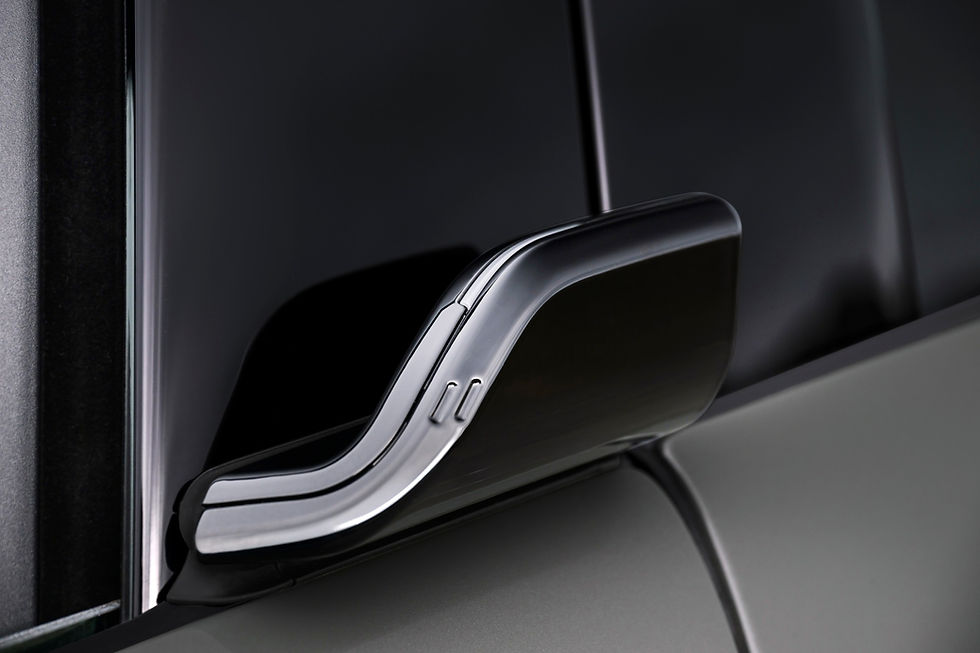
While bans are being debated elsewhere, BMW is taking its own path with the new X5 (G65). Instead of classic handles or fully flush pop-out solutions, the G65 becomes the first mass-production model to introduce the so-called BMW Winglets: small, glossy black fins integrated at an angle into the window frames at the B- and C-pillars, visually recalling the limited-run Skytop and Speedtop models as well as the 2024 "Neue Klasse X" concept. The larger X7 is expected to follow in 2027.
The Winglets are operated with a gentle touch of the sensor, optionally supported by a servo motor that cracks the door open, or alternatively via iDrive or the My BMW app. Unlike purely electric pop-out handles, BMW explicitly emphasizes a mechanical fallback here: should the electronics fail, the manufacturer says the door can still be opened mechanically – hardly a coincidence given the safety debate around power loss described earlier. The X5 also comes standard with soft-close doors, and for the first time on a BMW SUV, optional automatic doors are available that close themselves once the brake pedal is pressed.
With this, BMW positions itself deliberately between the two extremes: no step back to the classic handle, but also no compromise solution lacking mechanical backup like some competitors offer. Whether the Winglets establish themselves as a design language across further model lines will likely also depend on how well the concept holds up in everyday use – especially with ice, snow, or dirty sensor surfaces.
Safety Over Wind Tunnel: The Pushback From China
China plans to ban purely electrically operated door handles without a mechanical fallback starting January 1, 2027. The background: documented cases where, after accidents that collapsed the 12-volt electrical system, handles remained flush and made it harder for first responders to quickly reach occupants. The new rule doesn't ban flush handles outright, but requires a robust, easy-to-find mechanical emergency release that works without power. Purely hand-operated pop-out handles in the style of Tesla or Aston Martin, where pressing one side is enough to mechanically flip the handle out, remain unaffected.
For manufacturers like BMW that are active in the Chinese market, this is more than a footnote: models like the 7 Series, the i7, or the iX3 would need technical adjustments for that market. The ADAC (Germany's automobile club) also explicitly advises owners of vehicles with purely electric door release to familiarize themselves with the emergency release in the owner's manual before driving – and to show it to their passengers, too.
A Small Part With a Big Impact
In miniature, the door handle tells the bigger story of automotive engineering: from mechanical elegance through pragmatic robustness to fully digitalized, aerodynamically optimized solutions – and now back to the realization that safety and emergency usability shouldn't be sacrificed for the sake of styling. With the Winglets on the new X5, BMW shows that design boldness and a mechanical fallback don't have to be mutually exclusive. It wouldn't be surprising if this principle soon finds its way into further Neue Klasse model lines as well.
Meine Blog Artikel erstelle ich aus folgenden Quellen und Hilfsmittel:
Quellen: BMW Press Group, Google, Instagram, Erfahrungen aus dem Auto Gewerbe
Hilfsmittel: Für die Grammatik der Texte nutze ich Google Gemini und Claude


Comments