
The New BMW 3 Series: Electric, Six-Cylinder, Neue Klasse – the Eighth Generation Is Open for Orders.
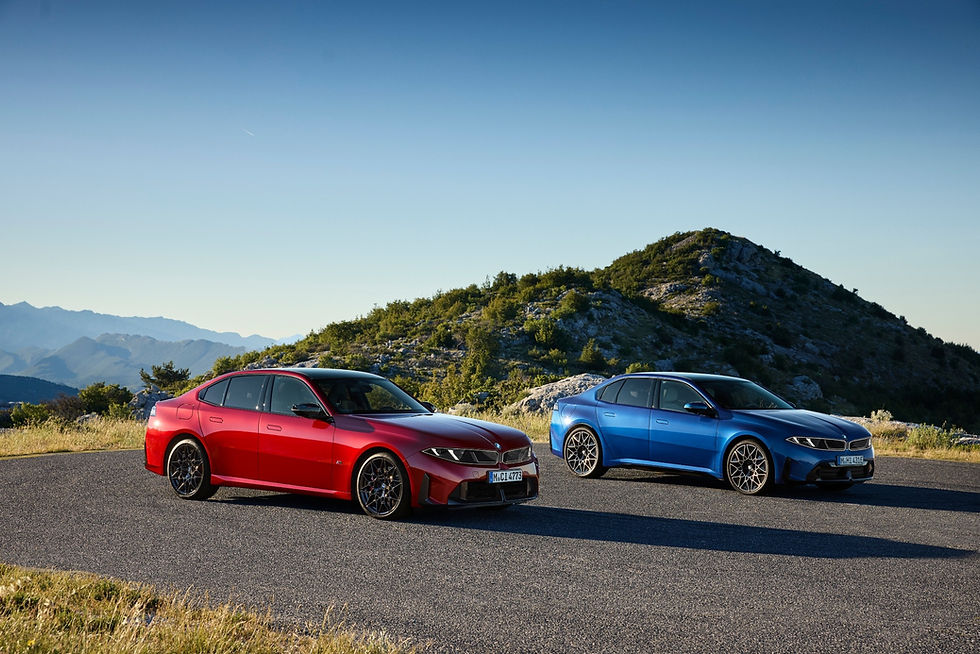
For more than five decades, the BMW 3 Series has been the benchmark in the sporty mid-size segment. With the eighth generation, BMW is taking the biggest leap in the model's history: for the first time, the 3 Series is available fully electric as the BMW i3 based on the Neue Klasse – alongside petrol engines, including an inline six in the new BMW M350 xDrive. Orders open today, 30 September 2026.
One Design for Every Drivetrain
The fully electric BMW i3 (NA0) and the combustion-engined 3 Series (G50) share the same Neue Klasse design and differ only in details dictated by their respective drive concepts.
The saloon features a modern 2.5-box design with a long wheelbase, short overhangs and a greenhouse pulled far back. Combined with the strongly flared wheel arches, this creates an athletic shoulder line, while a low character line brings the visual centre of gravity closer to the road. The door handles sit flush and extend automatically when the car is unlocked.
At the front, the kidney grille and twin headlights merge into a continuous light signature – the four-eyed face, reinterpreted. The M Performance models are identified by M Yellow Lights borrowed from motorsport. The rear features strongly horizontal lights and emphasises the wide track.
Compared with its G20 predecessor, the new 3 Series has grown moderately: the BMW i3 is 4,760 mm long with a 2,897 mm wheelbase, the combustion model measures 4,765 mm with a 2,860 mm wheelbase (G20: 4,713 mm / 2,851 mm). Track widths are also significantly wider.
Wheels range from 19 to 21 inches on the i3 and 18 to 20 inches on the combustion models. The M Sport package and M Sport package Pro are optional, and the exclusive M Le Castellet Blue metallic joins the colour palette. BMW Individual paint finishes follow during 2027.
Interior: Panoramic iDrive Arrives
Inside, the 3 Series adopts the reduced design language of the Neue Klasse. The centrepiece is BMW Panoramic iDrive with four elements: BMW Panoramic Vision (projection across the full width of the windscreen), the optional BMW 3D Head-Up Display, a 17.9-inch central display in Free-Cut design angled towards the driver, and the new multifunction steering wheel with a top centre spoke.
Lines flow from the doors into the instrument panel, creating a wrap-around effect. A large panoramic roof with climate comfort glass gives the cabin an airy feel. Standard seats are electrically adjustable with memory, while multifunction seats, M Sport seats and Harman Kardon sound systems are optional.
On the software side, BMW Operating System X runs on the Android Open Source Project (AOSP) and is designed for regular updates. The BMW Intelligent Personal Assistant gains Amazon Alexa+ AI technology, making it considerably more conversational.
BMW i3: Up to 912 km Range and 400 kW Charging
The BMW i3 uses the sixth generation of BMW eDrive technology: new high-voltage batteries with round cells, 800-volt technology and bidirectional charging. Two versions are available at launch, each with one electric motor on the front and rear axle:
BMW i3 40 xDrive: 275 kW/374 hp, 520 Nm, 0–100 km/h in 5.4 s, 82.8 kWh battery, up to 710 km (WLTP), up to 300 kW DC, up to 337 km in 10 minutes, 17.9–14.3 kWh/100 km
BMW i3 50 xDrive: 345 kW/469 hp, 645 Nm, 0–100 km/h in 4.7 s, 108.7 kWh battery, up to 912 km (WLTP), up to 400 kW DC, up to 423 km in 10 minutes, 18.0–13.4 kWh/100 km
AC charging is available at up to 22 kW. Via Vehicle-to-Load, external devices can be powered with up to 3.7 kW – turning the i3 into a mobile power bank.
The electric flagship, the BMW i3 M60 xDrive, follows in 2027.
BMW M350 xDrive: Inline Six with Drift Mode
For those who prefer combustion, the BMW M350 xDrive is the new top model – and the entry point into the world of BMW M. Under the bonnet sits a 3.0-litre inline six with 48-volt mild hybrid and crankshaft starter generator. System output is 326 kW/443 hp and 580 Nm, 0–100 km/h takes 4.1 seconds, and top speed is electronically limited to 250 km/h.
The real highlight is new: Drift Moment lets the driver shift all drive torque to the rear wheels via the central display – a feature previously reserved for BMW M GmbH high-performance models. The Adaptive M suspension is standard on the M350, along with Launch Control, M Logo Projection and the BMW Iconic Glow exterior package.
Below it sit two four-cylinder models, also with 48-volt mild hybrid and 8-speed Steptronic:
BMW 318: 115 kW/156 hp, 250 Nm, 0–100 km/h in 9.5 s, 215 km/h
BMW 320: 155 kW/211 hp, 330 Nm, 0–100 km/h in 7.4 s, 240 km/h
A plug-in hybrid will join the line-up during the coming year.
Heart of Joy and Four Superbrains
In the BMW i3, the Heart of Joy high-performance computer combines all drivetrain and driving dynamics functions in a single control unit for the first time – according to BMW, ten times faster than previous systems. One detail you'll notice in everyday driving: Soft-Stop is said to deliver the smoothest stopping in BMW history.
In total, the i3 uses four so-called Superbrain computers (driving dynamics, automated driving and parking, infotainment, basic and comfort functions), delivering around 20 times the computing power of the previous generation. The zonal electronics architecture with Smart eFuses instead of conventional fuses saves cabling, weight and energy.
The combustion model also gets its own BMW Driving Stack, tuned to its drivetrains – BMW sees Heart of Joy as a guiding principle across all drive types.
Hands-Free, Including Switzerland
All new 3 Series models offer SAE Level 2 assistance systems with BMW Symbiotic Drive. The Motorway Assistant enables hands-free driving up to 130 km/h in 21 countries – by the end of 2026 including Switzerland and Liechtenstein. From 2027, navigation-guided, partially automated functions for urban areas will be added. Driving Assistant Plus is standard.
Production: Munich, Dingolfing, Steyr
The BMW i3 is built at the Munich parent plant – where the first 3 Series rolled off the line in 1975. From 2027, Munich will produce exclusively fully electric Neue Klasse models. The combustion-engined 3 Series moves to Dingolfing, drive components come from Steyr and the high-voltage batteries from the new Irlbach-Strasskirchen plant. According to BMW, i3 production costs are around ten percent lower at series launch.
Prices and Standard Equipment
Starting prices for Germany:
BMW 318: from EUR 49,900
BMW 320: from EUR 54,900
BMW i3 40 xDrive: from EUR 59,900
BMW i3 50 xDrive: from EUR 65,900
BMW M350 xDrive: from EUR 80,900
Swiss prices have not yet been announced in this press kit.
Standard equipment includes BMW Panoramic Vision, Comfort Access, electric seats with memory, front seat heating, 2-zone automatic climate control, Driving Assistant Plus, a 7-speaker HiFi system and a 5G Wi-Fi hotspot.
The new BMW 3 Series is far more than a generational change. BMW shows consistently what technology openness means: the same design, the same operating concept – and a free choice between a fully electric i3 with more than 900 km of range and an inline six with drift mode. With more than 18 million units sold, the 3 Series is the brand's most successful model. The eighth generation has everything it needs to continue that story.
All figures preliminary; consumption and equipment data refer to the German market. Source: BMW Group press information 09/2026.
Meine Blog Artikel erstelle ich aus folgenden Quellen und Hilfsmittel:
Quellen: BMW Press Group, Google, Instagram, Erfahrungen aus dem Auto Gewerbe
Hilfsmittel: Für die Grammatik der Texte nutze ich Google Gemini und Claude


Comments