
Neue Klasse accelerates: Why the 2-million mark matters for BMW's revenue.

BMW is stepping on the gas when it comes to electrification – and for the company, there's far more at stake than image alone. Since the launch of the very first BMW i3 in late 2013, the BMW Group has delivered two million fully electric vehicles (BEVs) to customers worldwide.
Adding plug-in hybrids to the count, roughly 3.5 million electrified vehicles have gone to customers since 2013. In the first half of 2026, more than one in four vehicles sold worldwide was already electrified. For BMW, this isn't just a milestone announcement – it's a concrete sales and revenue signal: the Neue Klasse is selling, and it's doing so at a pace that matters for the company's future.
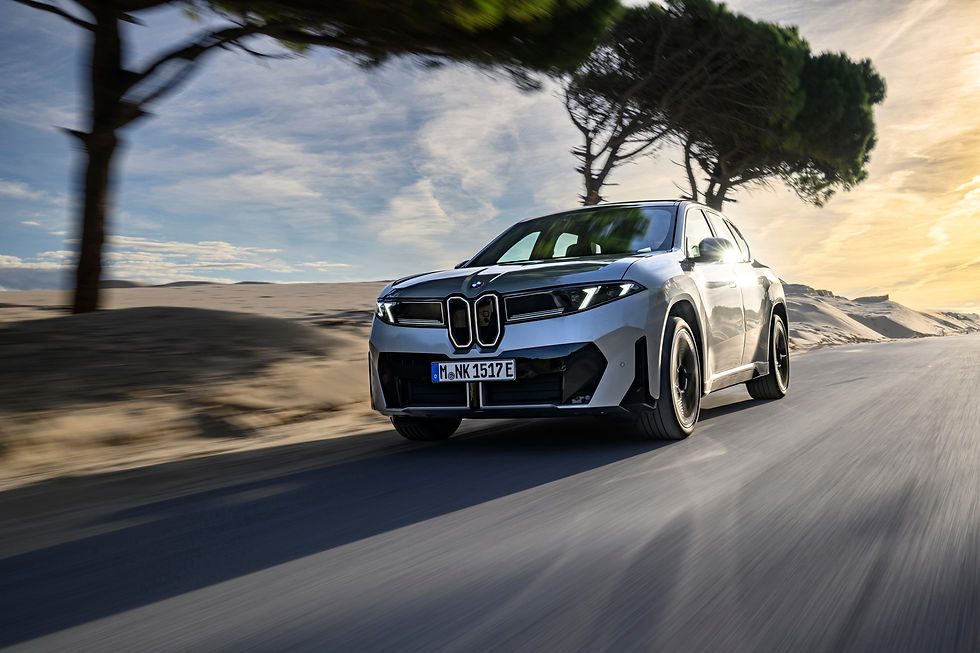
The iX3 as the sales and revenue driver
The largest share of this growth currently comes from the BMW iX3, the first Neue Klasse model. In Europe, BEV sales rose 38 percent to 81,445 units in the second quarter of 2026, driven by the growing availability of the iX3. In the first half of 2026, fully electric vehicles accounted for around 28 percent of BMW's total European sales. Since its world premiere, one in three fully electric BMW vehicles ordered in Europe has been an iX3 – and within the X3 family, every second customer now opts for the electric variant. According to BMW, the milestone of 100,000 iX3 orders is imminent. Every one of these orders feeds directly into the revenue BMW generates from the Neue Klasse – and that's where the real significance for the company lies.
As it happens, the two-millionth fully electric vehicle was a BMW i5 M60 xDrive, built in Dingolfing and delivered to a customer in Spain.
i3 series production has started
At the same time, BMW Group Plant Munich began series production of the new BMW i3 in August, the second Neue Klasse model. Demand is already high shortly after the brought-forward order start, giving Munich a correspondingly steep ramp-up curve – another volume model that further secures sales figures, and with them revenue, for the Neue Klasse.
Growth driver: the next wave of models is rolling in
For BMW, one thing is clear: this momentum can only be sustained if the market keeps receiving new Neue Klasse models. That's exactly what the company is currently pushing forward on several fronts:
BMW i3 Touring: The wagon derivative of the i3 sedan has been announced for 2027 and is already being tested on the Nürburgring Nordschleife. Until now, a market launch in the third or fourth quarter of 2027 was considered likely. According to rumors, however, the sales start is now set to be moved forward by around two quarters – meaning the Touring could reach dealers as early as the first half of 2027. This hasn't been officially confirmed, but it would fit the pattern BMW already showed with the i3, where the order start was also moved up at short notice due to high demand. As a traditionally popular body style among business customers and families, an earlier launch would give an extra boost to the Touring's sales and revenue contribution.
BMW iX4: The electric SUV coupé based on the iX3 (internally NA7) enters production at the Debrecen plant from November 2026, with the 40 xDrive and 50 xDrive versions arriving as 2027 model-year vehicles, followed by the M60 xDrive in March 2027. With a starting price above the iX3, BMW is tapping into an additional, higher-margin market segment.
Further derivatives: With the next-generation 3 Series, a possible iX3 M, and further Neue Klasse models through 2027, BMW is systematically expanding its lineup to be present in as many segments as possible at once.
Each of these models extends the Neue Klasse's sales base and reduces dependence on any single vehicle – an important factor not just for sustaining the current sales momentum, but for accelerating it further.
The combustion-engine 3 Series secures the revenue base
While the Neue Klasse focuses on electrification, BMW is making sure in parallel that the classic combustion-engine business doesn't fall behind. The new 3 Series (G50) adopts the Neue Klasse's design language and some technical elements, but technically remains on the proven CLAR platform and will continue to be offered with petrol, diesel, and mild-hybrid powertrains. Series production is set to begin in November 2026, with the first versions – 318, 320, 330 xDrive, and M350 xDrive – expected to launch around the turn of the year 2026/2027. Further variants, such as the 330e plug-in hybrid, will follow in 2027.
For the Group, this is more than just a model update: the 3 Series has been the brand's highest-revenue volume model for decades, and a large share of customers worldwide aren't yet ready to switch directly to a pure electric vehicle. By bringing the combustion-engine 3 Series to market in the same design and technology language as the i3, BMW secures this revenue base while the electric Neue Klasse grows in parallel – two pillars supporting each other through the transition period rather than competing for the same customers.
MINI: the Neue Klasse's next revenue potential
So far, the Neue Klasse has mainly been a BMW-brand story – but that's likely to change in the medium term. The BMW Group has already confirmed that the Neue Klasse's technological foundation, particularly the sixth-generation eDrive technology (Gen6) with its 800-volt architecture, new cylindrical battery cells, roughly 30 percent faster charging, and more than 30 percent greater range, is meant to benefit not just BMW, but also Rolls-Royce and MINI. For the next generation of electric MINI models, a shift from the brand's traditional front-wheel drive to rear- or all-wheel drive is even being discussed – a first for a brand that has relied on front-wheel drive since the 1960s.
Since the MINI Cooper, Aceman, and Countryman were only fully renewed in 2023/2024, no major model offensive is expected before the end of 2027. That's precisely where the potential lies for BMW: once MINI transitions to Neue Klasse technology in the coming years, the Group will be able to amortize the already-developed, margin-rich platform across an entire additional model family – extra volume and revenue without incurring the Neue Klasse's development costs a second time. For the long-term profitability of the Neue Klasse investment, that's a factor that shouldn't be underestimated.
Jochen Goller, the BMW Board Member responsible for Customer, Brand and Sales, sums up what the numbers mean: two million BEVs sold show just how much customers worldwide are embracing electric BMW and MINI models – and that the Neue Klasse is the decisive lever for the continued ramp-up of electromobility across the BMW Group.
Our take
For us as BMW watchers, this is more than just a milestone announcement: it's proof that the Neue Klasse isn't just convincing on paper or in its design – it's showing up in the sales figures too. With the iX3 and i3, only two of many announced models are on the market so far. If the i3 Touring, iX4, and further derivatives arrive as planned, BMW should be able not just to sustain its current growth curve, but to noticeably accelerate it – with correspondingly positive effects on the Group's sales and revenue. And with MINI, an entire brand is still waiting, in the medium term, to benefit from the Neue Klasse.
Meine Blog Artikel erstelle ich aus folgenden Quellen und Hilfsmittel:
Quellen: BMW Press Group, Google, Instagram, Erfahrungen aus dem Auto Gewerbe
Hilfsmittel: Für die Grammatik der Texte nutze ich Google Gemini und Claude


Comments